Top 7 Modern Construction Technologies Transforming the Indian Real Estate Industry
The real estate industry in India is developing rapidly due to innovation and the need for faster, safer, and more efficient building processes. The current Civil Construction is no longer restricted to the old approaches because it has involved the use of advanced technologies that are transforming the way projects are designed, implemented and maintained.
1. Building Information Modelling (BIM)
BIM is transforming the design and management of construction projects. It enables the architects, engineers and contractors to collaborate on a digital model. This minimises mistakes, enhances coordination and assists in delivering projects within the due time at a cost that is well controlled.
2. Civil Engineering Internet of Things (IoT).
IoT has enabled Civil Engineering to give the construction sites a smart appearance. The sensors are able to check the equipment, material tracking, and provide worker security. Instant information assists the project managers in making improved decisions and prevents accidents and delays.
3. 3D printing in construction.
In India, 3D printing is gaining popularity due to its capability to construct structures within a short period of time and with less wastage. It is particularly applicable to the low-cost housing projects. India already has some pilot projects that have reduced construction time by up to 30-40 per cent.
4. Civil Engineering Augmented Reality.
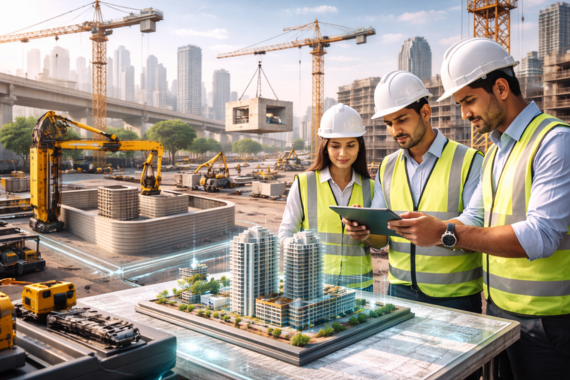
The AR in Civil Engineering enables practitioners to superimpose computer-generated designs in the physical world. It assists in the visualisation of projects prior to construction, the detection of design defects in time, and the enhancement of communication between teams and clients.
5. Civil Engineering Virtual Reality.
Civil Engineering Virtual Reality goes a step further to establish visualisation with the help of creating immersive experiences. The clients have the opportunity to go through a project prior to its construction. This improves the accuracy of planning and brings satisfaction to clients, as it provides a clear picture of the end result.
6. Civil engineering Robotics.
Civil Engineering Robotics is assisting in the automation of tasks which are repetitive and hazardous, like bricklaying, concrete pouring and demolition. These machines make the work more accurate, less prone to human error and safer on the construction site.
7. Modular Construction and Prefabrication.
Prefabrication entails the production of building parts off-site and assembly on-site. The technique saves time in construction, minimises waste, and improves quality control. It is becoming acceptable in residential and commercial buildings in India.
Conclusion
The construction industry in Indian real estate is shifting towards smarter, more efficient practices. Technologies such as BIM, IoT, AR, VR, and robotics are not just trends; they are fundamental to the future of the construction industry. With ever-increasing urbanisation, such innovations will be the main pillar for sustaining demand for quality and sustainability.
To enable companies that wish to keep pace with such developments, there are firms such as Gamut Buildcon operating in this dynamic environment, adapting to modernised construction trends and playing a role in the industry’s current transformation.
Search
Featured Blogs