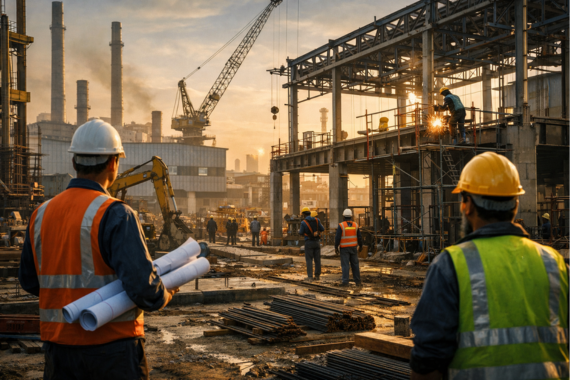
Industrial Building Construction in India: Planning, Safety, and Structural Excellence
The construction of industrial buildings in India is a critical part of the manufacturing, logistics, warehousing, and massive operations. As the rapid industrial growth and development have taken place, the need to have well planned, safe and structurally sound buildings that hold industrial structures has grown tremendously. Manufacturing construction requires proper planning, high-level safety standards, and high-performance of buildings in the long term.
Significance of Strategic Planning
Any construction project in an industry is based on planning. Prior to the actual construction, land choice, soil testing, zoning and environmental approvals would be considered. In industries, layouts are to accommodate the heavy machineries, storage systems, ventilation, and expansion in the future.
India is guided by national codes of building and industrial standards in order to produce long-lasting and safe buildings. Timelines and budgets can also be controlled with the help of detailed planning, this is the reason why most projects are implemented with the help of organized models such as turnkey project construction in Noida and other large industrial zones. These models enable improved coordination of design, engineering and execution.
Industrial construction safety standards
The issue of safety is very important in construction of industrial buildings because of the magnitude of work and the use of heavy equipment. Industry reports indicate that almost 24% of workplace deaths in India involve construction implying the need to comply with safety.
The industrial sites have stringent safety measures, including correct scaffolding, fire prevention and control, electrical grounding, and protective gear of the workers. The adherence to the regulations provided by the governments such as the National Building Code (NBC) and state labor departments is the guarantee of safer working conditions. Safety practices are also highly regulated in areas where there is high industrialization particularly among giant contractors who undertake projects in Delhi NCR.
Design and Engineering excellence
The industrial buildings need to be structure-wise strong in order to bear heavy weight, vibrations and extended working hours. Common structures used in industrial facilities include steel structures, reinforced concrete structures and pre-engineered buildings (PEBs).
Structures are built by engineers to resist seismic activity, great wind loads and wear. The advanced methods of construction are useful in increasing the life of industrial buildings and also minimizing the cost of maintenance. This engineering attention to precision is a common phenomenon in the projects which are handled by turnkey contractors in Delhi NCR and other industrial centres.
Turnkey Construction Models Role
In India, industrial construction has also turned into the popular method of constructing turnkey buildings. In this model, one contractor deals with design, procurement, construction and hand over. This minimizes the problem of coordination, and enhances accountability.
Areas such as Gurgaon and Delhi have experienced consistent demand of turnkey projects contractors in Gurgaon because of accelerated project delivery and reduced implementation hassles. On the same note, availability of mature turnkey contractors in Delhi assists industries to run on strict operational timelines.
Conclusion
The construction of industrial buildings in India is still in development whereby its planning is done in a better way, safety consciousness and structural engineering. The necessity of the execution models reliability and compliance with the national standards are even greater with the development of industries. Gamut Buildcon is one of the companies engaged in this industry operating in the industrial construction ecosystem in India though it is compatible with the traditional construction practices and regulations.
Search
Featured Blogs